


Training
To raise awareness and make the notions of ecological impact and planetary boundaries more accessible, we go out to meet the general public to inform, share and pass on key environmental knowledge.
Trainings
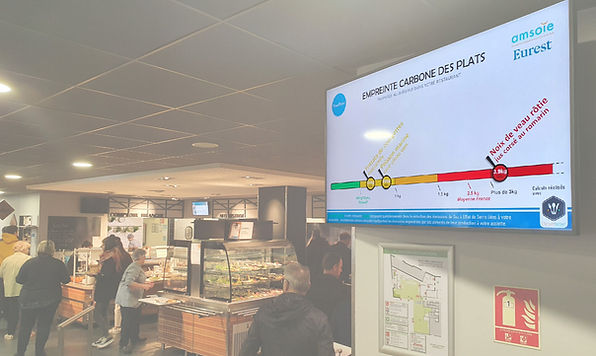
Former et informer : c'est le duo parfait pour impacter durablement l'évolution des pratiques alimentaires à grande échelle. En complément de l'affichage environnemental, nous proposons donc également des services de formations à destination des professionnels de la restauration (commis, chefs de cuisine, managers, directeur.ice.s de site, etc.). Voici deux exemples de notre catalogue, à la journée ou demi-journée.

Food, Climate, Health
In this module, we make scientific knowledge around climate change more accessible, with a particular focus on food and its Greenhouse Gas (GHG) emissions. We also draw the connection between environmental health and public health.
Food Waste
This training module aims to provide a comprehensive overview of food waste in France: its challenges, causes and existing solutions to reduce it. We guide participants in developing innovative solutions that can be implemented right away in their restaurant.


Workshops
We put our expertise in environmental impacts to use by going out to meet the general public at various events.
This is the case, for example, with the "Barbecue de Demain" organised with Grenoble Alpes Métropole and the caterer Radiselle in October 2022 and October 2023, or the facilitation of a Climate Fresk at the Maison de l'Innovation de Saint Martin d'Hères in January 2023.
We pass on environmental culture in a fun and engaging way, adapting our approach to all types of audiences: children, young people, older generations, beginners, initiated...
How to integrate sustainable eating habits into daily life, while contributing to personal health and environmental protection.
Simplifying subjects such as reducing food waste, choosing low-impact foods, and understanding eco-labels.